Tuning & fine-tuning
Speaking rate, creativity, time limits, pronunciation, recording and background audio.
The Tuning area holds the dials you reach for once the agent is doing the right things but does not yet feel right. Four pages, each with a clear job.
Parameters
Speed
The speaking rate of the voice, from slow to fast, where 1.00 is the voice's own normal pace.
Values slightly above 1.00 make most German voices sound more alert and less ponderous. From roughly 1.25 upwards it starts to feel rushed, and numbers, names and addresses become hard for the caller to write down.
Temperature
How tightly or how freely the language model answers.
| Range | Behaviour | Good for |
|---|---|---|
| low | Answers stay close to the prompt and repeat themselves in similar situations | Booking, data capture, anything with a fixed flow |
| medium | A good compromise between reliability and natural phrasing | The usual starting point |
| high | Freer, more varied phrasing, but less predictable | Advisory and open-ended conversations |
Prompt first, temperature second
When the agent answers incorrectly, temperature is almost never the cause. Fix the prompt first and only tune temperature once the content is right.
Max call duration
After this time the platform ends the call automatically. It is a cost guard against calls that run on with nobody on the other end.
Max wait time
How long the agent tolerates silence before prompting or hanging up. Set too short, it talks over callers who are simply thinking. Set too long, it creates awkward pauses.
Speech recognition
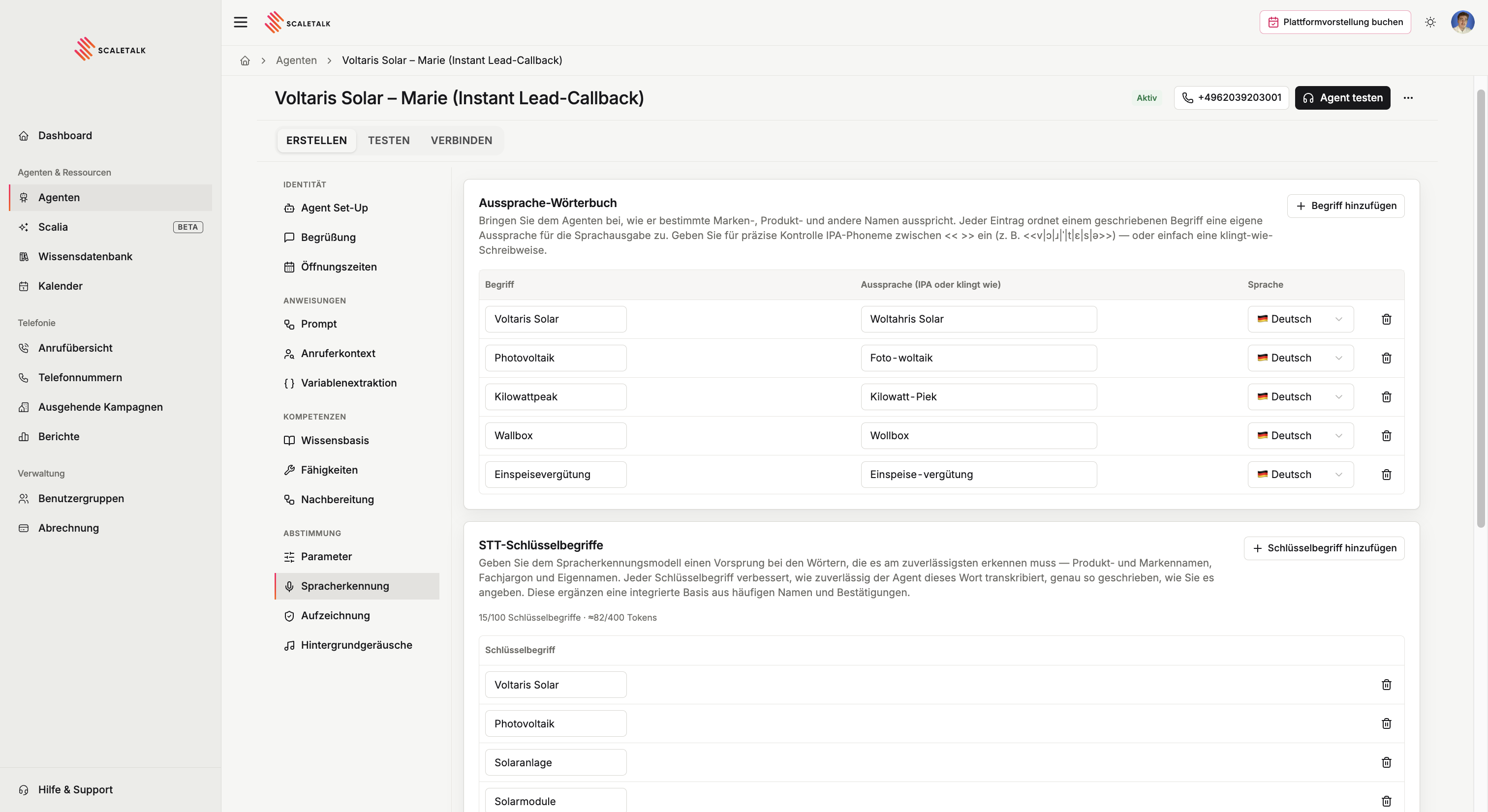
This is where you teach the agent your vocabulary. Two separate tools that are easily confused:
| Tool | Direction | Effect |
|---|---|---|
| Pronunciation dictionary | Output | How the agent says a word |
| STT keyterms | Input | How reliably the agent hears a word |
Pronunciation dictionary
Each entry maps a written term to its own pronunciation, either as a sounds-like spelling or as IPA phonemes between double angle brackets:
Chaiselongue   →   shayz-long
Voltaris       →   <<v|ɔ|ɹ|ˈ|t|ɛ|s|ə>>
Per entry you choose the language it applies to, or select All languages.
Typical candidates are brand names, product names, loanwords and proper nouns, precisely the words where a mispronunciation instantly sounds unprofessional.
STT keyterms
Keyterms give speech recognition a head start on words it has to get right. Each term is transcribed exactly as you spell it.
The platform shows current usage as you type, both the number of terms and the resulting token consumption. Both limits apply at once, so long terms use more budget than short ones.
Only what is genuinely hard
Common first names and confirmations are already covered by a built-in baseline. Spend the budget on what makes your industry specific: product names, jargon and place names.
Recording
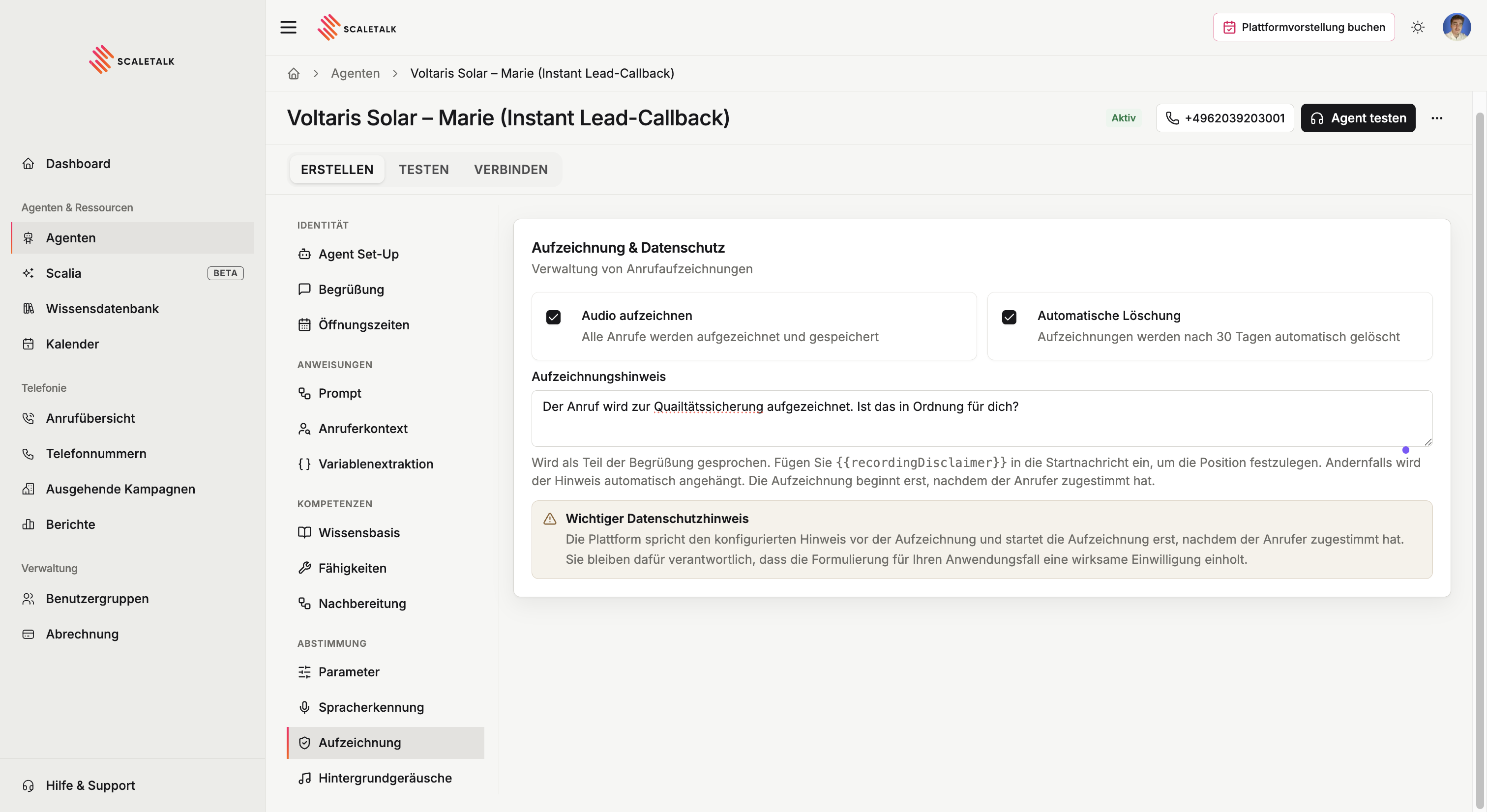
Controls whether calls are recorded.
| Setting | Meaning |
|---|---|
| Record audio | All calls for this agent are recorded and stored |
| Automatic deletion | Recordings are deleted automatically after a set retention period |
| Recording disclaimer | The text the agent uses to obtain consent |
Obtaining consent
Once a disclaimer is saved, the agent speaks it and only starts recording after the caller agrees. Without a saved disclaimer it does not ask for consent at all.
Where the disclaimer falls in the conversation is controlled by the {{recordingDisclaimer}} placeholder in the opening message. Without the placeholder, the platform appends the disclaimer to the greeting automatically.
The wording is your responsibility
The platform speaks the disclaimer and starts recording only after consent. Whether your wording obtains valid consent depends on your use case and remains your responsibility. In Germany, recording a phone call without the consent of everyone involved is unlawful.
Background audio
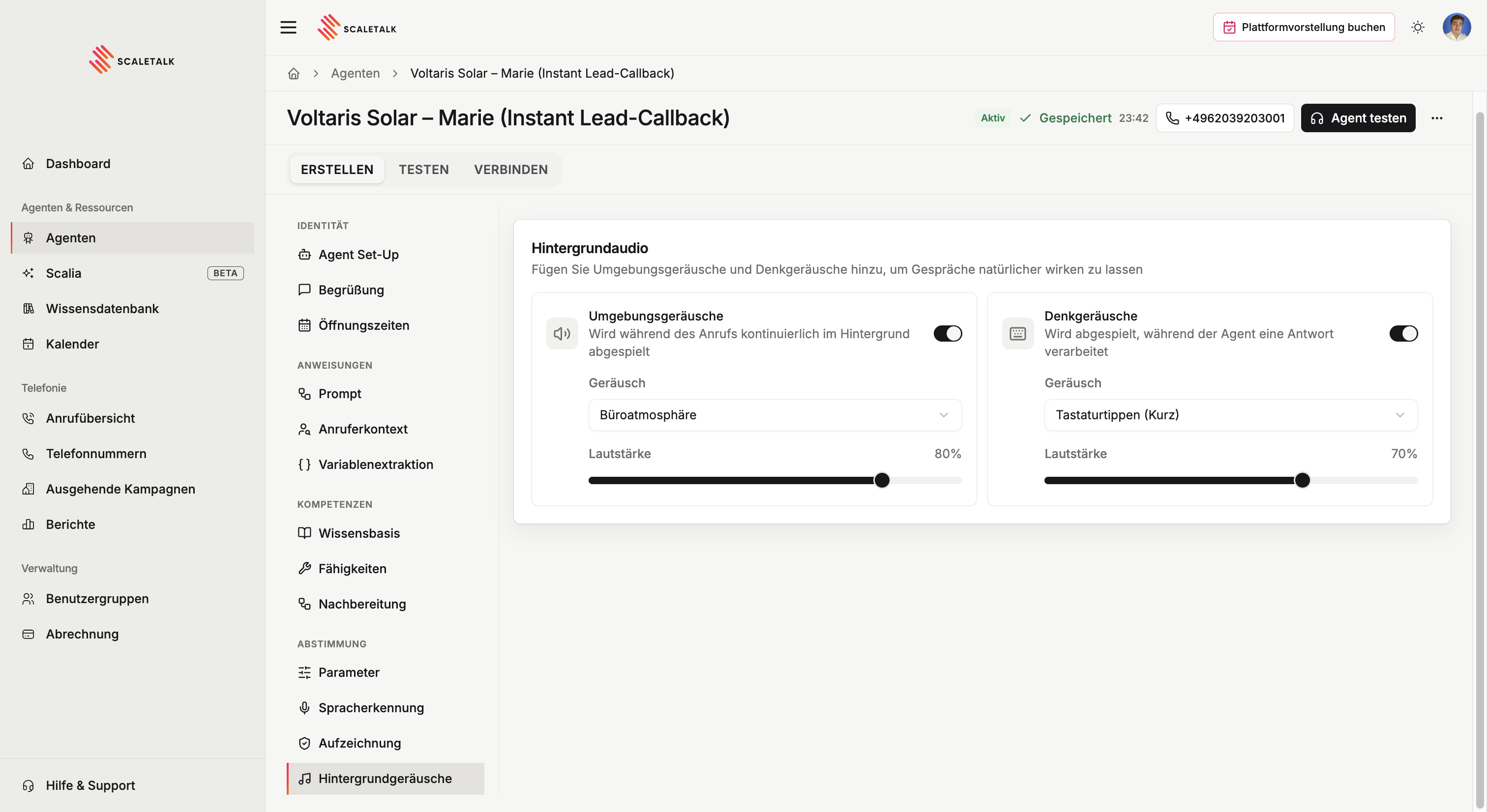
Two independent tracks that make calls feel less sterile.
| Track | When it plays |
|---|---|
| Ambient sound | Continuously in the background, for example an office atmosphere |
| Thinking sound | Only while the agent is processing an answer, for example keyboard typing |
Each has its own volume. Thinking sounds audibly bridge processing time and take the artificial edge off the pause.
Keep it quiet
Background audio is meant to work subconsciously. The moment a caller notices it, it is too loud. Always check the setting on a real phone call rather than the browser test, because a phone line sounds different.